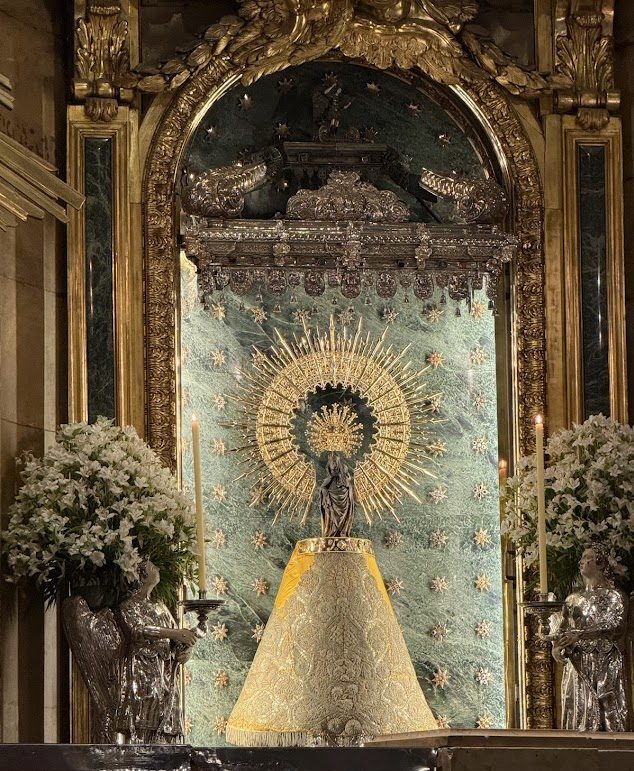
This past month I was blessed with the opportunity to participate in a pilgrimage to Spain. We spent a significant amount of time in Zaragoza at the Basilica of Our Lady of the Pillar. Like most of our readers, I had never heard of Our Lady of the Pillar before, but my encounter with her was quite profound. I couldn’t help but reflect with her on the nature of hope and our work in the propagation of the Gospel of Life.
In 40 AD, Our Lady miraculously appeared to St. James the Greater while he was preaching in what we would now call modern-day Spain. This event marked the first-ever Marian apparition, even though it was technically a bilocation since Mary was still alive and living with James’s brother, John. What struck me most about this apparition though was how great and timely her support was for her adopted son. She appeared to St. James at the very moment he was losing hope.
St. James had been preaching to the people in this region for a long time. He was facing the kind of discouragement and lack of fruit that our readers are likely very familiar with. Though our current problems and circumstances are different, the nature of sin has stayed the same. While we face unprecedented violations against human dignity via abortion, IVF, and assisted suicide, the root causes of these crises remain the same: a loss of meaning, identity, community, and purpose. These are the same types of wounds St. James encountered while preaching to the people of Spain. He had the unique advantage of having personally met and been discipled by Jesus of Nazareth, yet he was still unable to convince the people that Christ was their Savior and their God.
Hopelessness can be quite an invasive species. It seeps into our hearts, our emotions, our thoughts. We lose sight of the things of heaven and give in to the culture’s pervasive narrative of darkness, isolation, and death. The cure to this despair is simple though, it requires us to reorient ourselves to Christ. Our Lady appeared to St. James to remind of this truth. She did not come alone; she carried with her the Christ Child, the very embodiment of hope. She appeared as any loving mother does, at the moment her child was in dire need. Her maternal gaze captured his heart and re-centered it on her Son. She also shared words of consolation, assuring him that “the faith you establish here will be firmer and last longer than the pillar I stand upon.”
St. James built a chapel to our Lady over that pillar, and then, newly inspired, he continued his mission. Just two years after this encounter St. James would return to Jersualem to become the first martyr among the apostles. What great hope he must have received from our Lord through our Lady, hope that endured even unto death.
Bishop Daniel E. Thomas, the newly appointed chairman of the USCCB’s Pro Life Secretariat, recently addressed pro-life diocesan directors at a national conference. In his remarks, he shared three anchors of hope we can cling to when we face desolation or discouragement. He encouraged us to participate in and with the Eucharist, to rededicate ourselves to personal prayer and silence, and finally, to look to Mary.
Perhaps as we continue our work in pro-life ministry, we can follow Bishop’s advice with renewed vigor having seen such a strong example of hope in Our Lady of the Pillar’s appearance to St. James. We know that the special love that drew her St. James draws her to us too. The fruits of our labors may not be seen or known to us in this lifetime, but just as assuredly as her pillar still stands in that ancient Basilica in Zaragoza, our work, too, will not be so easily forgotten or destroyed.
By Emily Branscum