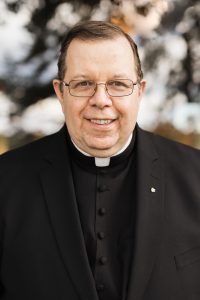
Fr. Martin Fox
Pastor
NE-9 Family of Parishes
As I write this, I’m killing time before a meeting later. And I’m reading items on Facebook. That includes people I know and respect, expressing deep unhappiness about the “Beacons of Light” reorganization plan now being implemented in the Archdiocese of Cincinnati.
The basic thing is organizing approximately 200 parishes into approximately 55 or so “families,” but eventually, they will become 55 or so combined legal entities. This upsets people, understandably, because it means what had been a stand-alone parish will become part of a larger, multi-site parish. Many people are deeply concerned that what they love will go away.
There are many angles from which to approach this. Let me try to hit them all briefly.
First: what will or won’t “go away.”
There’s NO GOOD REASON (but could be BAD ones) for any “parish” to “go away.” Let me explain the quotes, because I think a lot of the unhappiness derives from the multivalent meaning of words.
When you say “my parish,” do you mean the legal structure; or do you mean the physical place; or do you mean the community of people for whom the legal structure was created, and for whom the place is a center of gravity? Three different realities, they are not identical or coterminous.
To add clarity, let me create three clunky terms: “parish-corporation,” “parish-place” and “parish-people.” Follow? Hang with me please
The legal structure is boring but important.
A parish, under church law, is essentially a corporation. It stands apart from other parish-corporations, and therefore, the persons who are legally responsible for them must administer them in a certain way. That means the pastor, who alone — other than the bishop — has the legal authority to act on behalf of that parish-corporation. His moral and legal duty to administer that corporation is serious, and it is greatly complicated when he is asked to administer more than one, of the multiple parish-corporations are adjacent to, or intertwined with, each other. This is not well understood by those who get upset about Beacons of Light.
That said, changing the legal structure — i.e., combining multiple parish-corporations into a united parish-corporation — does not necessarily change a whole lot for the parish-place and parish-people involved.
Imagine in the town of Happy Valley, you have three parishes: St. Kunagunda, St. Sylvester and St. Christina the Astonishing. At one time, each was helmed by separate pastors; but for various reasons, they now share a single pastor, and have for some time, and are almost certain to be so led for the indefinite future.
I will skip over, for now, why combining the three parish-corporations into one is advisable, and just assume that it is will happen. What does this change for the physical locations and the people who gravitate there? Does it force any outcome?
The answer is NO. There is no necessity that any of the three locations undergo a single, meaningful change. There might be changes in tax ID numbers, or record-keeping. There would likely be signs saying, “St. Kunagunda Church, part of St. Oddo Parish.” But all the activities that took place the day before the combining of legal structures are still underway the day after.
I know what you’re saying: but it’s a prelude to closing ___ Parish!
Tell me, what benefit would there be to anyone to close a church that is well attended and well supported (as opposed to one that is neither)? What does the pastor or bishop gain by doing it?
Other than misery, alienation and people who used to give, but no longer will?
Only an extremely stupid pastor or bishop would mess with success. I’m not saying there aren’t stupid pastors or bishops. I’m saying, that’s not usually the case — not that stupid.
Pretty often, the closure comes because people drift away, the money needed to keep things going isn’t there, debts mount, and then…why be surprised if the place closes?
On the other hand, if the people will support keeping a place active, there is no benefit to fighting them, and great benefit in giving them what they want.
Now, if there aren’t enough priests, that may affect the number of Masses. But in the case of Beacons of Light, that isn’t the critical issue. The issue that is generating great unhappiness in some quarters is precisely the legal structures changing, which are taken (I think) to presage other changes.
All I mean to do is challenge that assumption. I think a very good argument can be made (and I will try presently to make it) that combining the corporate structure can and will have the opposite effect, of benefitting the life of the parish-places and parish-people.
Second: why you don’t really want a pastor to helm multiple (i.e., independent) parishes
This is what many people think they want. They want their parish-place and parish-people to stay on their own as they have been. They fear the combination of the parish-corporation will inevitably lead to the end of what they love about parish-place and parish-people.
There is a kernel of truth in this, which I will touch on below. But let’s deal with why you actually don’t want to maintain the go-it-alone parish structures, when the multiple parishes share now, and will for an indefinite time to come, share a pastor.
A pastor has a moral duty to that parish-corporation that must not be compromised. He must act in its best interest. He must review records, keep track of all assets, that is, the “patrimony,” and he must lead the pastoral care of the parish-people. If he is asked to do this not only for St. Kunagunda, but also St. Christina the Astonishing, etc., he must act, in effect, as three separate pastors. This is the point that isn’t really understood until you’ve lived it. Very often, the pastor must “personify” his parish, especially in relation to other parishes. This is bound up with how Canon law describes him as the “juridical person.”
So think about that: Father Ernest, Pastor of St. Sylvester, must personify that parish to Father Ernest (himself!), pastor of St. Christina; then, again, he must represent those to, to himself, as pastor of St. Kunagunda.
Couldn’t he conflate these distinct fiduciary responsibilities? Yes! It’s called combining the parish-corporations into one; but as long as there are distinct corporations, he must manage, somehow, to avoid a conflict of interests. And they come up rather more frequently than you may realize. They are not so hard to avoid if he has good cooperation among the lay collaborators of the several parishes; but that doesn’t always happen. Then what?
If you maintain separate legal entities, then you must maintain separate accounts, separate books, separate inventories of assets, and separate lines of accountability. This multiplies the time the pastor must spend reviewing books and inventories; and it adds a special complication: creating special structures and methods of preventing improper commingling; and avoiding suspicion of the same.
Let me summarize it this way. I’ve lived this reality both where there is good cooperation and refusal to cooperate; the latter is awful, but the former is still difficult. My first year in my present assignment – leading three distinct parishes that will eventually come together — was made so much more bearable because everyone knew we were moving toward becoming one family. Had that not been in view, the past year would have been extremely difficult.
To state it simply: if you don’t understand why this is difficult for the pastor, ask questions and listen.
Two examples, both real:
- a) Parish-corporations that share pastors will inevitably share some expenses, perhaps quite a lot of expenses, especially if they share employees. Quite a lot of time will be spent on analyzing, proposing, debating, negotiating, implementing, and evaluating plans of sharing and distributing those expenses. Then it all has to be re-done every few years, because the odds of getting it right the first time are nil. It’s all about what’s “fair,” and that is far from obvious or uniform. “Fair” is whatever everyone can live with.
- b) Pastors will inevitably be moving from site to site as they carry out their duties. It becomes tremendously easy for valuable items to “drift” from site to site with him. As a result, it’s remarkably easy for sacred vessels, vestments, ritual books and other things to migrate. Not a big deal, until it is. “Where’s the ciborium that was donated 50 years ago?” It may seem a small thing, but again, from actual experience, it’s a headache to keep track of, but if I don’t make sure it’s attended to, it can become a real problem and an injustice.
Some will say, but the pastor should simply give responsibility for money, for budgeting, for oversight, to others! Let him focus on spiritual things!
First, that’s a kind of gnosticism to separate the temporal from the spiritual. God didn’t create us as angels, but as body-soul combinations.
Second, what that really means is that the priest goes from being the leader of the parish, to an employee. Whoever makes the decisions about the physical assets is in charge, whether that be the priest, or a deacon, or a single layperson, or a committee of laypeople. The latter was tried: it was called “trusteeism.” It became a huge problem, and a recent example is the sad story of St. Stanislaus Kostka Church in St. Louis. Short story: a Catholic parish, administered by a lay corporation, ended up not being a Catholic parish. A bad end for anyone who wants to safeguard the parish-place and parish-people by demoting the priest from leader to “sacramental minister.” And don’t tell me, “but that’s not what we intend!” The good folks who set St. Stanislaus on that bad road didn’t intend the outcome either.
Third, the other option is to accept poor pastoral leadership as “normal”: if a man must lead multiple, legally separate parish-corporations, he will be a miserable pastor who tries, but fails, to do an impossible job; or an absentee pastor who happily doesn’t try. Hard to see how either is good for the parish-people or parish-place, even as it protects the independence of the parish-corporations!
The point I’m making is this: given the reality of not enough pastor-capable priests, that narrows our options. I wish it were otherwise! But for now, and for the foreseeable future, we have too many parishes for too few pastors. At this point, combining the parish-corporation offers a way to minimize the pastor’s time spent complying with the demands of muliple parish-corporations, increasing the time he can give to the parish-places and parish-people.
And here’s a point I wanted to make earlier. A lot of people are mad at the Archbishop, and those he consulted, about this whole reorganization — as if this came out of nowhere. The event you are unhappy about didn’t happen in the last two or three years; it was already underway 20-plus years ago: when we knew pastors leading multiple parishes was the reality that wasn’t going to change quickly. I’m not saying it cannot change; and to his credit, Archbishop Schnurr has tried to change it. But at some point, you can’t pretend reality isn’t real, especially when it comes at the cost of miserable pastors who are told they must give their parishioners the pretense of things not changing all that much, or do-the-minimum pastors who let things go; they will go for quite awhile before people realize how far gone things are.
Yes, combining parishes does involve loss
I’m not going to pretend it is all positive. There is something lost when you no longer have each church (parish-place) as a stand-alone parish-corporation. When you create a new, larger entity — call it the combo-parish — helmed by a single pastor, it isn’t only the legal structures that become one. In some fashion, it all becomes one.
Indeed, the term “family” is very helpful here. Has anyone ever heard of a family that embraces more than one physical home? With multiple traditions and activities, that not all take part in? Of course! Isn’t that exactly how most extended families operate?
I realize this raises questions, but it seems to me, most of the success or failure of this depends on how people respond. If the people who identify with St. Sylvester must start to share their beloved church, and events, with people who identify with St. Christina and St. Kunagunda, is it really all “loss”?
Cannot each part of this new family have a moment to consider, “what special thing do I bring to this family?” Each member of a family is unique; yet part of the larger family. So cannot St. Kunagunda continue to be a special parish-people and parish-place, while becoming part of a united parish-corporation? I readily believe it can fail: but please tell me why you think it must fail.
Father Martin Fox is pastor of the NE-9 Family of Parishes, including Our Lady of Good Hope, Saint Mary of the Assumption and Saint Henry, in Dayton. This article first appeared at Fox’s blog, Bonfire of the Vanities.