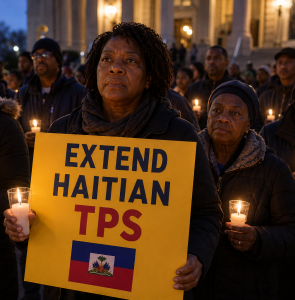
 The U.S. Supreme Court’s recent decision allowing the Trump administration to end Temporary Protected Status (TPS) for Haitian immigrants has understandably caused great concern among many Catholics. While the Court’s ruling addressed a legal question about the authority of the executive branch and the limits of judicial review, it also highlights a deeper moral question that now falls squarely on our nation’s elected leaders.
Temporary Protected Status is not an immigration loophole. It is a humanitarian program established by Congress that allows people already in the United States to remain and work legally when extraordinary conditions in their home country make a safe return impossible. Haitians first received TPS following the devastating 2010 earthquake, and subsequent administrations of both political parties repeatedly renewed those protections because Haiti continued to suffer from political instability, gang violence, natural disasters, and humanitarian collapse. Even today, the U.S. State Department continues to warn Americans not to travel to Haiti because of widespread kidnapping, violent crime, and the near collapse of civil order. It is difficult to argue that conditions have improved to the point that returning families is now safe.
The Catholic Church has long affirmed that sovereign nations have the right—and even the responsibility—to regulate their borders and immigration policies for the common good. At the same time, Catholic teaching insists that governments exercise this authority with justice and compassion, particularly toward those fleeing grave danger.
This case is not about people who entered the country unlawfully. It concerns individuals who were legally admitted under a program created by Congress, who have lived and worked in our communities for years, raised families, attended our churches, paid taxes, and contributed to our economy. They accepted the invitation our nation extended because returning home was deemed too dangerous.
Ohio’s Catholic bishops recently described efforts to end TPS protections for Haitians as “a moral failure.” In their joint statement, America at 250: Freedom and the Common Good, they remind Catholics that concern for migrants and refugees is not a partisan issue but a matter of human dignity rooted in the Gospel. They call upon our nation to pursue immigration policies that uphold both the rule of law and the dignity of every human person.
It is worthy of mention that the Supreme Court’s task is not to determine whether a policy is morally wise or compassionate, but whether the executive branch acted within the authority granted by the Constitution and laws enacted by Congress. Whether one agrees with the Court’s legal reasoning or not, Congress possessed the authority throughout this process to modify the TPS statute or otherwise protect Haitians who had been lawfully living and working in the United States. It did not do so. The Court’s decision therefore does not end the conversation. The administration bears responsibility for choosing to terminate Haiti’s TPS designation, but Congress also bears responsibility for declining to exercise its constitutional authority to provide continued protection for people who remain unable to return safely to their homeland.
As Catholics, however, we are not called simply to point fingers. We are called to respond with hope. We can pray for immigrant families living with uncertainty, support parish ministries that accompany newcomers, advocate respectfully for policies that protect vulnerable people while honoring the rule of law, and welcome those whom God has placed in our communities. Christ reminds us that when we welcome the stranger, we welcome Him. Our response to our Haitian brothers and sisters offers another opportunity to live that Gospel with both truth and charity.